

Local SEO and Google Business Profile · exotic and luxury car rental only
The booking goes to whoever Google puts in the top three.
Somebody in your city searched for exactly what you own, and three businesses appeared before anything else. Your best car spent the weekend parked. That order is decided by how a Google Business Profile is configured, not by what is in the garage.
Google is not looking at your cars.
It is matching text. Relevance, distance, prominence. Relevance is the one you control almost entirely, and it is decided by information you either entered into your profile or did not.
Which is why an operator running four cars out of a leased bay can sit above an operator running eighteen. One of them filled in the services tab. The other left it empty.
The best rated business is not the one at the top.
Read the order. First place holds 4.5 stars. Two businesses below it hold a clean 5.0, one of them on 149 reviews. The pack is not a ranking of quality and it is not a ranking of fleet. It is relevance, distance and prominence, and the profile that answers the query best takes the position.
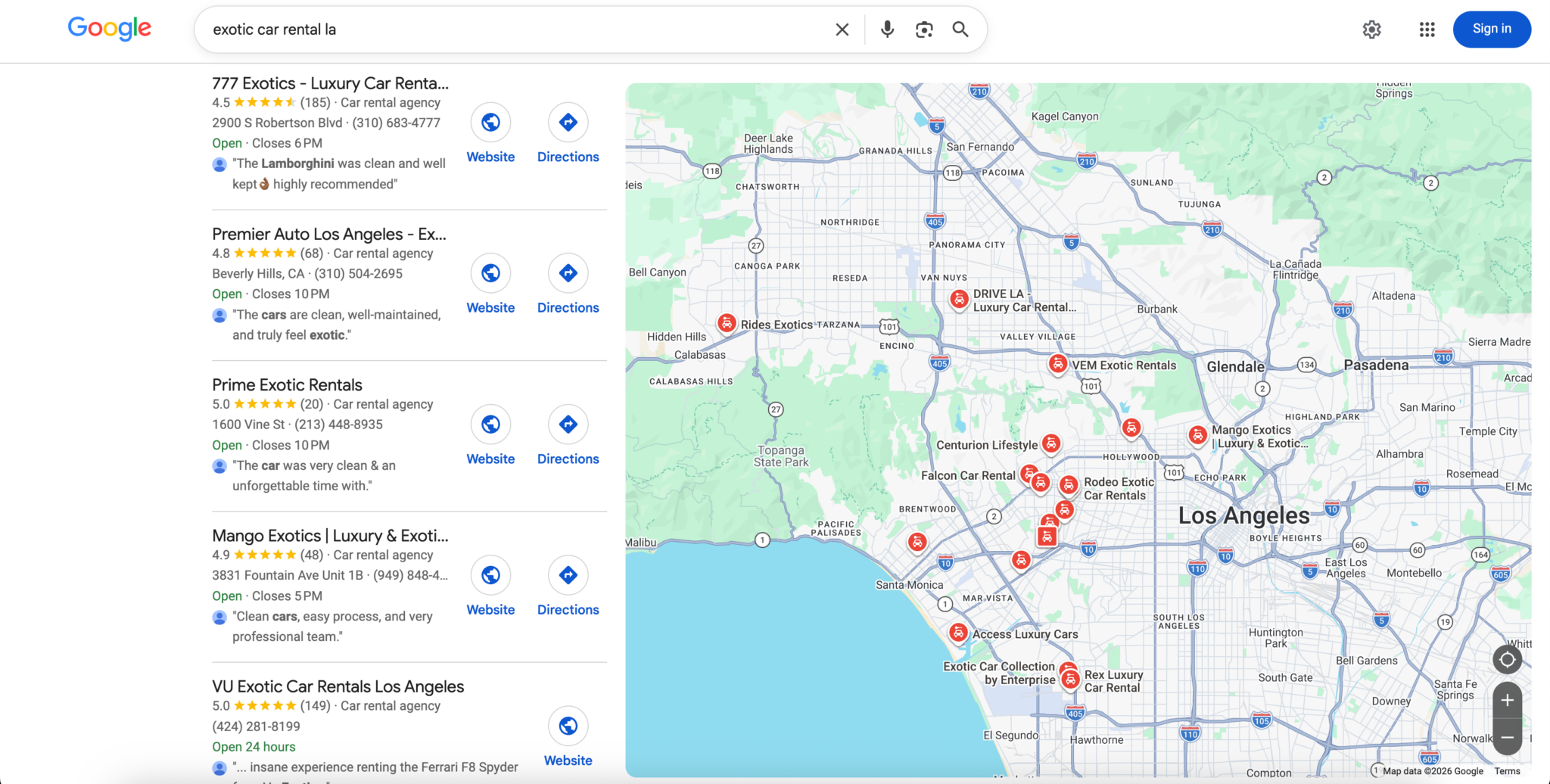
Google local results for “exotic car rental la”, captured 17 September 2026. Pack order changes continually; this is a snapshot of one day, not a current ranking.
Your own audit is never published. It is written for you, sent by email, and it stays there.

What I measure, and what I do with it.
Every profile I look at is scored on five dimensions, twenty points each. Nothing subjective. A category is either active or it is not. The finished audit goes to you privately and is never shown to anyone else, so what follows is the framework rather than somebody’s result.
Category coverage
/ 20Google uses categories as matching signals, and each active category opens a distinct set of queries a profile is eligible for. Most profiles in this industry run one where several legitimately apply, which quietly removes them from searches they would otherwise win.
Services
/ 20Indexed separately from the description, which makes it extra keyword surface rather than a repeat of it. In exotic rental it matters more than anywhere, because your inventory has proper nouns attached. Nobody searches “exotic car rental.” They search for a car.
Photos and posts
/ 20Two effects that compound. A profile whose newest photo is fourteen months old looks dormant to somebody comparing three options at this price point, and it gives Google nothing new to associate with the business.
Review management
/ 20Not the total. The arrival rate, the response rate, and what the replies say. Volume runs low in this industry because people rent once or twice a year, so each individual review carries more weight than in almost any other local category.
Questions and answers
/ 20An open field anybody can post to, including a competitor. The questions here are identical in every market: minimum age, deposit, insurance, mileage, delivery, chauffeur. Leaving them unanswered hands the narrative to whoever answers first.
Then the same sequence, every time.
No engagement starts with a proposal. It starts with the audit, delivered privately, and you are free to take it to somebody else.
Days 1 to 30 · structural
Fix what is configuration
- Categories and attributes completed
- Services built out with pricing
- Description rewritten in full
- Photo batch uploaded and named
- Every existing review answered
- Q&A seeded against real queries
Days 31 to 60 · activity
Build what needs repetition
- Posts twice weekly, about something
- Monthly photo batches
- Review requests firing automatically
- Citation inconsistencies corrected
- Seasonal posts mapped to the calendar
- Booking link and messaging enabled
Days 61 to 90 · compounding
Extend and measure
- Citation footprint widened
- Review velocity sustained
- Structured data added to the site
- Local pack tracking, weekly
- Competitor movement flagged
- Q&A expanded from real queries

One industry. Mine happens to be yours.
I work only with exotic and luxury car rental operators. Not restaurants, not law firms, not general local business. The reason is not branding.
The ranking work here has a shape: few transactions at high value, a customer who researches carefully because of the price, demand that spikes around events, a fleet list that maps directly onto keyword surface area, and a competitor set small enough that I can name every business above you and tell you what each one has that you do not.
A generalist agency arrives with a template built for volume businesses. The categories are wrong. The posts are about nothing. The review cadence assumes you serve forty customers a day.
Three tiers. Every one starts with the audit.
Starter
Fix every structural gap in the profile, then keep it maintained. For operators whose profile was set up once and never touched.
Full breakdownGrowth
Most commonEverything in Starter, plus citation work, monthly content, structured data and AI visibility monitoring. The standard retainer.
Full breakdownAuthority
Everything in Growth, plus local link acquisition, entity work and a quarterly competitor review. For operators intending to hold the top of their market.
Full breakdownTwo extra bookings a month cover the retainer several times over.
At $500 to $2,000 a rental day, this is arithmetic rather than persuasion. That is the whole reason this industry was worth specialising in.
Five markets taught me this. The mechanics travel.
Built studying the most competitive exotic rental markets in the United States, where operator density is highest and event-driven demand is sharpest.
Miami, FL
Highest concentration of independent operators in the US. Demand runs year-round rather than seasonally, which changes how review velocity and posting cadence should be paced.
Las Vegas, NV
Constant tourist volume produces steady high-intent search and an unusually contested keyword set. The Formula 1 weekend distorts demand for a fortnight each November in a way no other US market experiences.
Austin, TX
An event calendar anchored by the Grand Prix at Circuit of the Americas and SXSW. Less saturated than Miami, so structural profile work moves position faster here than almost anywhere.
Los Angeles, CA
Enormous, fragmented and geographically spread, which makes service area configuration matter more here than in any other market on this list.
San Diego, CA
High disposable income, lifestyle-driven demand, meaningfully less saturated than LA. Often the better market for an operator with a smaller fleet.
Built in these markets. Not limited to them.
Google’s local ranking system works the same way in Dubai, on the Gold Coast, in Marbella and in Monaco as it does in Miami. Categories are still matching signals. An empty services tab is still an empty services tab. What changes is the competitor set, the seasonality and the local citation landscape, and those get established during the audit rather than assumed.
Case study · my own site
I built a site in this niche to prove the strategy, then ranked it.
I do not operate a fleet. I built exoticcarrentalsandiego.com to test whether the approach I sell actually works in this industry, on my own money and my own time. It ranks, and the phone rings.
last 12 months
last 12 months
the United States
per week

The pattern in that table is the entire argument. The head term is brutal and the model-specific pages are not. Somebody searching “svj rental” knows exactly what they want and is close to booking, and almost nobody in this industry builds pages for them. The same logic applies to the services tab on your Business Profile.
Figures from Google Search Console, 12 months to 17 September 2026. Positions are 12-month averages, so current positions differ. Calls arrive on a tracked number and the count is my own. Because I do not run a fleet, those leads currently go nowhere, which is the honest limitation of the experiment and the reason I would rather be doing this for an operator who can answer them.
Questions operators ask first.
Will my audit ever appear on this website?+
Do I need a large review count to rank in the local three-pack?+
How long before rankings move?+
Can you guarantee a top three position?+
Why exotic car rental only?+
I operate outside the United States. Can you work with me?+
What is AEO, and does it matter yet?+
Find out what your profile actually scores.
I score your Business Profile on the five dimensions above, against the businesses currently ranking above you, and send it to you. Forty-eight hours, no cost, no follow-up sequence, and it never appears anywhere but your inbox.
Get your free GBP auditNo pitch. No contract. No obligation to reply.